
Three years ago, I almost lost a client in my first week with them.
Not because I missed a deadline. Not because the writing was bad. I lost their trust because I did what most writers do when they're excited about a new project: I opened a blank doc and started writing.
The blog I turned in was well-researched, well-structured, and completely wrong for them. It sounded like every other SaaS blog on the internet. It didn't sound like them. That one mistake taught me something I've carried into every project since: you cannot write good content for a brand you haven't actually studied.
I've spent the last 5+ years writing for founders and marketing teams across SaaS, Shopify and e-commerce, real estate, health and wellness, and IT, industries with almost nothing in common except one thing: every single one of them needed a strategist before they needed a writer. That realization is exactly why I built a repeatable content audit framework for new clients, and I run it before I write a single sentence, no matter how small the project is.
This post walks you through that exact process, the same one I use with every new client, so you can either run it yourself or understand exactly what you should expect from a content partner who takes this seriously.
Why I Never Start Writing Without an Audit First
Here's the honest truth: skipping the audit is faster in the short term and expensive in the long term.
When I skip it (and I have, on rushed projects), here's what happens: the content sounds generic, it competes with the client's own existing pages instead of complementing them, and I end up doing 2-3 rounds of revisions that a 3-day audit would have prevented entirely.
Knowing how to do a content audit before writing isn't a "nice to have" skill for a content strategist. It's the difference between being a writer someone hires once and being a partner someone keeps coming back to.
Here's a simple way I explain my process to clients when we kick off:
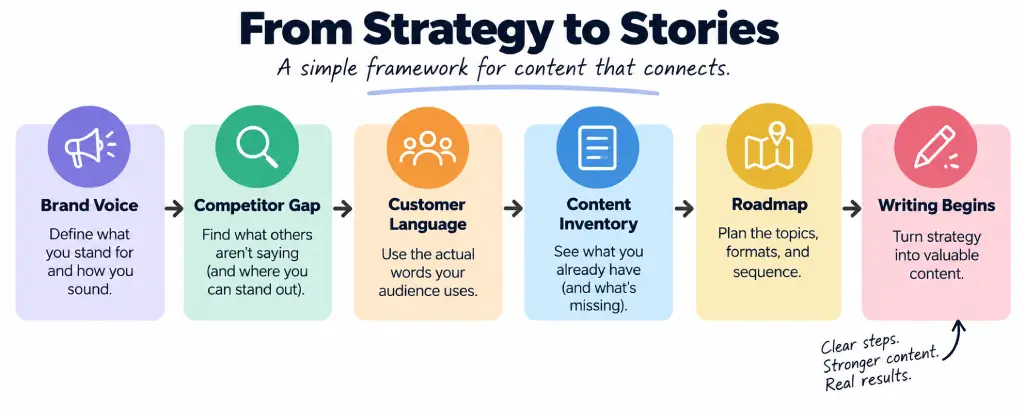
- New Client Onboarding
- Step 1: Brand Voice & Positioning Audit
- Step 2: Competitor & SERP Gap Analysis
- Step 3: Customer Language & Objection Mining
- Step 4: Content Inventory & Technical Health Check
- Step 5: Content Pillars + Prioritized Roadmap
- Writing Begins
01Auditing the Brand's Existing Voice & Positioning
The first thing I do isn't SEO-related at all, it's about listening. I read the client's homepage, about page, sales emails, and any existing blog posts and I'm noting things like: Do they say "we" or "I"? Are they formal or conversational? What phrases do they repeat? What do they avoid saying?
This step is quick, usually half a day, but it saves entire rounds of revisions later.
02Competitor & SERP Content Gap Analysis
This is where the SEO groundwork happens. I pull up the top-ranking pages for the client's target keywords and ask three questions: What are they covering that we're not? What are they missing that we could own? And what search intent is actually being rewarded right now?
This is genuinely the heart of how to do a content audit before writing anything that's meant to rank, not just sound nice.
03Customer Language & Objection Mining
Keyword tools tell you what people search. They don't tell you why. For that, I go straight to the source: product reviews, support tickets, sales call notes, even Reddit threads where real customers are complaining or asking questions in their own words.
This step has changed more headlines and hooks for me than any keyword tool ever has, because it captures the exact phrasing a buyer uses when they're frustrated or unsure, and that's language that converts.
04Content Inventory & Technical Health Check
This is the least glamorous step and the most important one for existing sites. I pull a full list of the client's current content along with performance data from Google Search Console and GA4: impressions, clicks, average position, and bounce rate.
This content inventory and performance metrics review tells me exactly what's working, what's quietly dying, and what's actively competing against itself.
Here's a simplified version of how I score and triage content in this step:
| Content status | Signal | Action |
|---|---|---|
| Ranking, low traffic | Good position, low CTR | Rewrite title/meta |
| High impressions, low clicks | Weak snippet or intent mismatch | Update intro & structure |
| Two pages targeting same keyword | Keyword cannibalization | Merge into one page |
| Outdated but relevant | Old stats, stale examples | Refresh & republish |
| No traffic, no relevance | Doesn't serve current strategy | Delete or redirect |
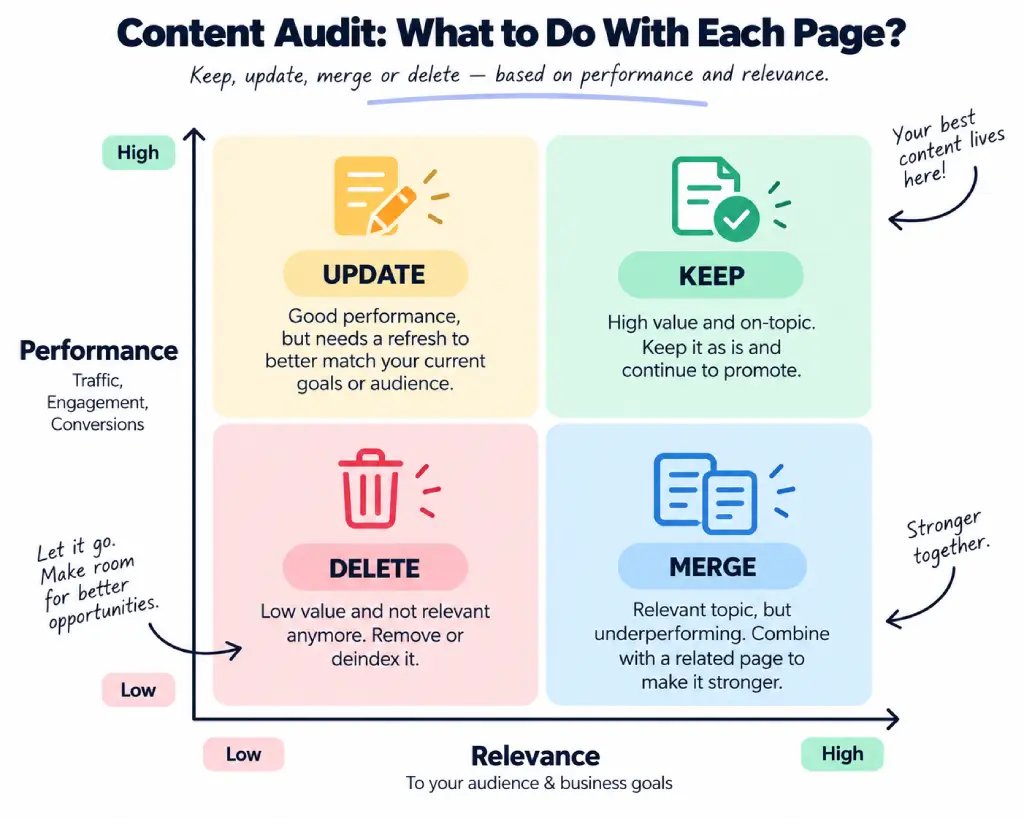
This is essentially a keep update merge delete content triage: every piece of existing content gets sorted into one of those five buckets before I write anything new. I also flag keyword cannibalization detection in audits specifically, because I've seen clients unknowingly compete against their own pages for months without realizing it was capping their rankings.
Here's a quick reference I share with clients so they understand what a proper SEO content audit checklist for clients actually covers:
| Audit area | What I check | Tool |
|---|---|---|
| Existing content performance | Clicks, impressions, position | Search Console |
| User behavior | Bounce rate, time on page | GA4 |
| Competitor gaps | Missing subtopics, weak angles | SERP tools |
| On-page issues | Thin content, broken internal links | Site crawl |
| Voice consistency | Tone, terminology, POV | Manual review |
05Defining Content Pillars and a Prioritized Roadmap
Once I have all of that laid out, the last step is turning it into an actual plan. I group findings into 3-5 core content pillars and then build a prioritized content roadmap after audit that ranks what to write, rewrite, or retire, and in what order, based on effort versus impact.
I always prioritize quick wins first (an existing page ranking on page 2 that just needs a content refresh) before moving into net-new, high-effort pieces. This keeps clients seeing traffic movement early, which builds trust in the bigger strategy.
What Changed When I Started Doing This
The difference has been measurable, not just anecdotal. Clients who go through this full process before I start writing typically see fewer revision rounds, faster content approval, and content that ranks with less "waiting and hoping" involved.
Grab the Checklist Version
If you want a quick, save-and-reuse version of this exact process, I turned it into a simple one-page checklist you can run before you (or your writer) publish the next blog post. Save it, print it, or check it off right before your next content sprint.
If you're a founder or marketer about to bring on a new content writer, ask them how they'd approach an audit before your first blog is even drafted. Their answer will tell you a lot about how the rest of the partnership will go.
FAQs
What is a content audit, and why does it matter before writing new content?
A content audit is a structured review of a brand's existing content, voice, competitors, and performance data before any new writing begins. It prevents generic content and ensures new pieces fill real, verified gaps instead of guesses.
How long does a content audit take before you start writing for a new client?
For most clients, my full audit takes about 3-5 days depending on how much existing content there is to review. For brand-new sites with no content history, it's usually faster since Steps 1-3 carry most of the weight.
Do I need a content audit if my website is brand new with no existing content?
Yes, just a lighter version. I skip the content inventory step and focus entirely on brand voice, competitor gap analysis, and customer language, so the very first pieces of content are already positioned correctly.
Can't AI tools just do a content audit automatically?
AI tools are genuinely useful for pulling GSC/GA4 data quickly and spotting patterns at scale, and I use them for exactly that. But the judgment calls, what a brand's voice should sound like, which gap is actually worth chasing, which page to merge versus delete, still need a human who understands the business, not just the data.
About the Author

Saloni Garg
8+ years of experience creating content across diverse industries — from SEO blogs and website content to social media and brand storytelling. I use AI as a tool to research, refine, and create more effectively, while keeping the human perspective at the core.